912Rwanda is Saving More Lives in the Golden Hour
December 5, 2025 2026-10-01 0:39912Rwanda is Saving More Lives in the Golden Hour
When a serious injury happens, every minute counts. The world has built emergency systems around the idea of a “golden hour”, the first 60 minutes after major trauma. Rapid, coordinated care can determine whether a patient survives and recovers. In high-income countries, ambulance services often aim to reach life-threatening emergencies within minutes, supported by digital dispatch systems and clear national standards.
Each year, an estimated 1.19 million people die on the roads, and 90% of these fatalities occur in low- and middle-income countries (LMICs). In these countries, long distances, traffic, limited ambulance fleets, and communication gaps mean injured people commonly wait a little longer beyond the golden hour. Reviews of prehospital trauma care in LMICs report that the most common time from injury to hospital is between 1 and 4 hours, with median journey times of around 80 minutes or more, well beyond the golden hour target.
Rwanda reflects this challenge in sharp focus. Injuries account for around 10% of all deaths nationally, and about half of those deaths occur before patients ever reach a hospital. Many of the remaining deaths occur within the first 24 hours of admission. For people with severe injuries, experts recommend reaching an appropriate hospital within one to two hours. Yet studies of ambulance journeys in Rwanda found average times of about one hour. Much of this delay was due to basic coordination: locating the patient, identifying a suitable hospital, and preparing that facility, all managed through stepwise phone calls and radio messages.
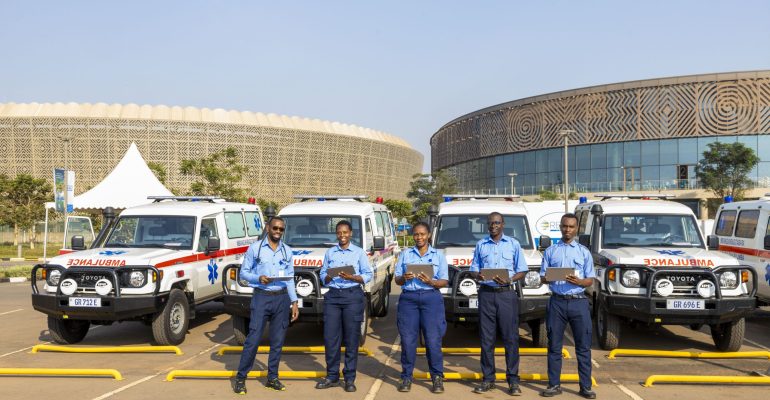
At the same time, Rwanda has built a strong foundation for emergency care. In 2007, the Ministry of Health created the Service d’Aide Médicale d’Urgence (SAMU), a national emergency medical service that has grown from a Kigali-based initiative into a nationwide network of more than 300 ambulances, coordinated through a central dispatch centre and a free emergency number, 912. This system has transformed access to urgent care, but relying on mobile phones and very high-frequency radios can slow communication, cause fragmentation, and lead to misunderstandings, wasting precious minutes.
To address this, a team of Rwandan and international partners – including the University of Global Health Equity (UGHE), the Rwanda Build Program, clinicians, researchers, ambulance providers, and policy-makers – co-designed 912Rwanda, an electronic communication platform that connects patients, ambulances, dispatchers, and hospitals in real time. This is not a standalone pilot or a separate service. It is a continuous, system-wide effort that builds directly on the existing SAMU and 912 infrastructures, upgrading the tools that responders use every day.
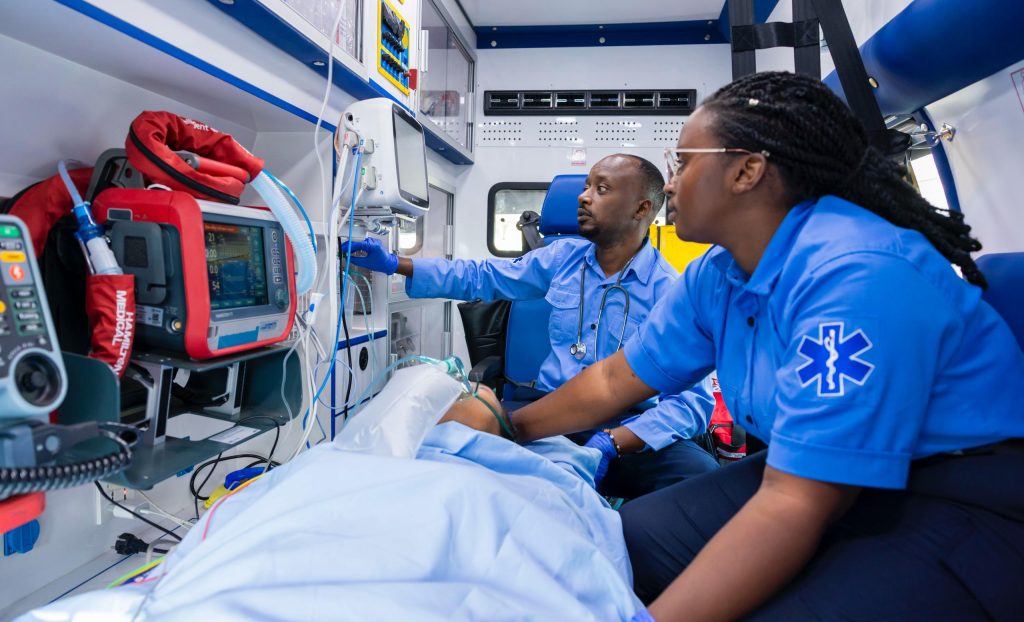
The first phase of 912Rwanda, already operating in Kigali, equips ambulance crews and dispatchers with GPS-enabled digital tools. These applications help teams pinpoint the scene, navigate efficiently, capture structured patient information, and send standardized updates directly to receiving hospitals, so that emergency rooms can prepare before the ambulance arrives. The second phase adds a destination decision support algorithm that helps match each patient to the nearest appropriate and ready facility, based on clinical needs and real-time information about hospital capacity. The system suggests a destination and explains why responders can accept or override the recommendation, and their choices and reasoning are recorded so that the platform can continue learning from real-world practice.
To understand the effect of implementing 912Rwanda on patient outcomes, the Rwanda912 RIGHT study follows its rollout over several years in two contrasting settings: Kigali and Musanze district in Northern Province. The study measures the total time from ambulance deployment to the patient’s arrival at a health facility, comparing data from before and after each implementation phase. It examines key intervals in this journey, including the time to reach the scene, on-scene duration, and travel time to the hospital. The research also assesses clinical outcomes, such as in-hospital mortality and length of stay, alongside the system’s feasibility, acceptability, and adoption rate among frontline lifesavers.
UGHE is an active partner throughout this process. The University helps co-lead the initiative and is involved in day-to-day activities; from coordination with SAMU and health facilities to supporting data collection, analysis, and continuous refinement of tools and workflows. Beyond technical and research roles, UGHE leads community engagement to ensure that 912Rwanda remains grounded in the realities of those most affected by injury.
The University has brought together a wide group of stakeholders, including traffic police, policymakers, motorcycle taxi representatives, community health workers, road injury victims, and healthcare providers, into groups in Kigali and Musanze. These groups are updated and involved at each step and new development. They advise on priorities, help interpret findings, and support communication of results in ways that resonate with both communities and decision-makers.
912Rwanda is a digital innovation, and ultimately about healthcare and people’s wellbeing. By strengthening the existing 912 emergency system, modernizing SAMU, and considering community voices into every stage of the project, Rwanda aims to ensure that injured people receive the right care in the right time. If this approach proves effective, it could provide a practical, scalable model for other low- and middle-income countries facing the same challenge: too many lives lost in the long, uncertain minutes between injury and hospital. Through sustained partnership and leadership – including the day-to-day work of institutions like UGHE – Rwanda is working to turn those minutes into a second chance at life.