From Stethoscope to Systems Change: Dr. Jean Eric Niyitanga on the Power of Equity in Action
January 22, 2026 2026-01-30 11:35From Stethoscope to Systems Change: Dr. Jean Eric Niyitanga on the Power of Equity in Action
From Stethoscope to Systems Change: Dr. Jean Eric Niyitanga on the Power of Equity in Action
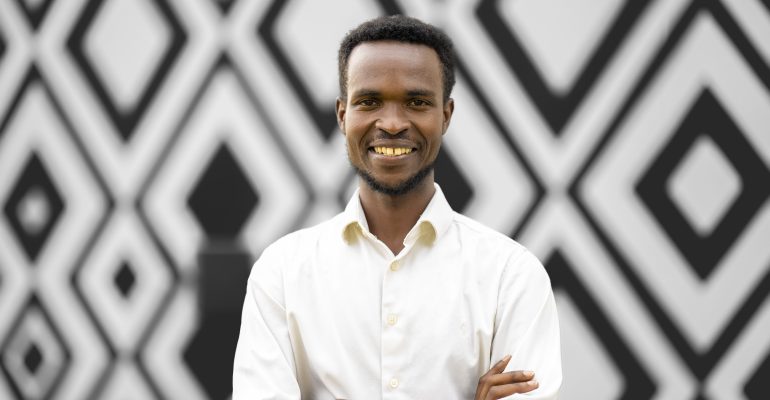
This Q&A highlights an insightful conversation with Dr. Jean Eric Niyitanga, a student in Master of Science in Global Health Delivery – Health Management option. We discussed his journey from clinical practice to transformational systems-level work, and his commitment to health equity. In the interview, Dr. Niyitanga reflects on the real-world experiences that shaped his understanding of healthcare inequities, explains what drew him to pursue advanced training in global health delivery, and shares how his work at the University of Global Health Equity (UGHE) embodies the university’s mission to advance equitable health systems for all.
Before joining UGHE, you worked in clinical care, community health, research, and health communication. Which experiences most shaped your early understanding of health inequities?
My early understanding of health inequities was most shaped by my first clinical rotation (clerkship) at a rural district hospital in Nyaruguru District, in the far southern part of Rwanda. Most of the patients we received had limited financial means, and some required advanced services that were not available at our hospital, such as CT scans, MRI for diagnosis, or advanced surgical procedures. All we could do was refer them to referral hospitals in Kigali or Butare.
However, I often heard patients say, “Doctor, I can’t afford the transport to go to Kigali. Can you just prescribe some medications to help me?” In many cases, the doctor had no choice but to rely on basic laboratory tests and clinical judgment, prescribe medications that were not always the best option but the most affordable, send the patient home, and hope for the best …though sometimes, the worst happened. This experience left a deep impression on me of how the poor unfairly suffer deaths and complications that were otherwise preventable. It also showed me how rural communities often have limited access to essential health services that urban communities enjoy with less concern.
Can you share a patient encounter from your clinical practice that fundamentally changed how you think about healthcare and access to care?
One morning, while rounding in the surgical ward at a district hospital in Kigali where I worked, I met a young man in his early twenties. He had been involved in a road traffic accident and sustained a fracture of the left thigh bone (femur). He had no caretaker. When I checked his records, I found that he had been lying in that bed for over three months, waiting for a surgical appointment at a referral hospital.
I asked why it had taken so long. He replied, “I missed my appointment because I haven’t been able to get the money to buy a material needed for my surgery (called an intramedullary nail), which my community-based health insurance doesn’t cover.”
By that time, his bone had started healing, but it was misaligned and crooked. As a result, his left leg had shortened, and without corrective surgery, he would limp for the rest of his life.
I felt angry at the insurance system, “how could an insurance scheme fail to cover such a common and essential procedure?” This encounter dramatically changed my perspective on healthcare: you can have great doctors and hospitals, but if the broader social and economic systems are not supportive, patients (especially the poor) will still suffer.
At what point did you realize that treating individual patients was not enough, and that lasting impact required working at the level of health systems and management?
The helplessness I felt during my encounter with that young man with a femur fracture, together with the many frustrations I experienced while advocating for similar patients through our hospital social department, became a turning point for me. I was confronted with the limits of my financial resources and personal influence. I realized that there were many more people I would never encounter who were suffering from the same systemic challenges. I began to feel that I should orient my career toward a field where I would not be addressing one problem at a time but instead working on systems that can move the needle across many problems at once.
What drew you to the Master of Science in Global Health Delivery (Health Management), and why was UGHE the right place for that journey?
I first became interested in UGHE in 2022 during the Conference on Public Health in Africa (CPHIA) in Kigali, when I was still a medical student. UGHE students and faculty presented their research and hosted a panel discussion on the impact of research in improving healthcare. I also spoke with the then Dean, Dr. Paul Tomlin, and learned about UGHE’s mission to train the next generation of health leaders who will transform global health. I was immediately interested, as I had always gravitated toward leadership roles in different youth communities, including the Medical Students’ Association of Rwanda.
A few years later, as I explored different career paths, advocacy, health leadership, and research felt like a natural fit for me.
“The MGHD program, with its training in health management, became my program of choice because it focuses on addressing root causes rather than just symptoms of healthcare problems, emphasizes systems thinking, and develops leadership. In addition, I wanted to tap into a network of professionals who are making an impact in healthcare. “
During your studies, you conducted award-winning research on loss to follow-up among NCD patients in rural clinics. What did this work teach you about the gaps between healthcare systems and patient realities?
Patients with chronic diseases such as diabetes and hypertension need regular appointments with health professionals to refill their medications and monitor their conditions. However, some patients go home and never come back. As health professionals, we often assume this is a matter of common sense: “you are sick, we are helping you get better, so you will keep coming as planned.”
My research revealed why patients in rural areas do what may seem illogical (they drop out of the follow up program). For some, transportation to health facilities was a major challenge. Others turned to traditional healers. Some did not have enough understanding of their disease or why follow-up matters; and others had relocated to different areas.
“This study taught me that if a health system is to work, it first should understand patients’ realities and respond to them accordingly.“
You are currently a Research Assistant in Palliative Care at UGHE’s Institute of Global Health Equity Research. How has this role deepened your understanding of equity, dignity, and patient-centered care?
Palliative care is a unique approach that recognizes that the suffering of patients with serious illnesses, such as cancer, goes beyond the physical pain in their bodies. It also includes social suffering for example, losing income due to disability), psychological suffering such as the anxiety of dying young and leaving behind small children, and spiritual suffering being at peace with oneself, with others, and with God, for those who believe.
“My work on a palliative care project involves collaborating with multiple stakeholders to design a model that relieves all forms of suffering, regardless of patients’ economic status, gender, race, or place of residence. This is health equity in action: a belief that even dying patients are still living, and that every patient and family should be treated as a unique entity with unique needs.”
As you graduate and look ahead, how do you hope to use your training to strengthen health systems to better serve communities in Rwanda and beyond?
The MGHD training has been truly transformative, equipping me with a strong health equity philosophy, practical leadership and management skills, and a rich global health network that enables me to lead with impact. I am committed to leveraging my research skills to rigorously understand health problems and design solutions that reduce suffering in my community, using my communication skills to advocate for systemic change, and empowering other global health professionals by sharing the knowledge and lessons I have gained.