UGHE Celebrates International Women’s Day with an Organisation Supporting Children with Disabilities and Their Mothers
March 16, 2026 2026-04-02 16:15UGHE Celebrates International Women’s Day with an Organisation Supporting Children with Disabilities and Their Mothers
UGHE Celebrates International Women’s Day with an Organisation Supporting Children with Disabilities and Their Mothers
For many years, mothers raising children with disabilities often carried a double burden. In some communities, disability was misunderstood, and families, especially mothers, were left to cope with stigma, isolation, and economic hardship. Children with disabilities were too often overlooked in education and health services, while their mothers were perceived as incapable or responsible for circumstances beyond their control.
Today, that narrative is changing.
Last Friday, the UGHE community paid a visit to an organisation whose mission is to transform the lives of children with disabilities through healthcare, education, and vocational empowerment; Shenge Children Organization (SCO). Together, we celebrated International Women’s Day.
SCO was founded by two women who believed that both children with disabilities and their mothers deserved dignity, opportunity, and support. What began as a response to exclusion has grown into a powerful example of community-driven care.
The organization has impacted the lives of 116 children with disabilities over the years. Currently, 34 children are receiving support through the center, while 30 others are visited regularly at home to ensure they are not left behind due to distance or mobility challenges.
Encouragingly, 18 children have graduated from SCO’s programs, and 11 children enrolled in special-needs education, a milestone that once seemed out of reach for many families.
Beyond education and care, SCO provides physiotherapy services, an essential intervention for children with physical disabilities. Eighteen of the children who benefited from these services have completed physiotherapy programs, improving their mobility and independence, and opening doors to future work and participation in society.
Yet the organization’s impact extends far beyond statistics. Its true strength lies in the mothers who stand at the heart of it.
Beatrice, a mother of three, remembers the painful isolation she experienced after giving birth to her first girl child, who has a disability.

“I suffered exclusion within my family because of my firstborn,” she recalls. After that, the second born was a boy, and had no disability. Beatrice was maltreated and later became worse as she discovered that her third born, who is a girl, also had disabilities at the age of 8 months.
“When I came here, I found comfort with other mothers facing the same issues.”
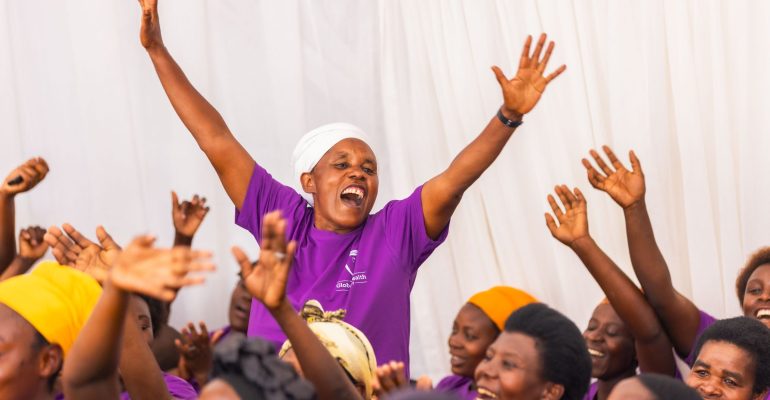
At Shenge Children Organisation (SCO), mothers discovered that they were not alone. What began as mutual support soon evolved into collective action. Together, the mothers started small income-generating activities such as animal rearing and weaving, helping restore both their financial independence and their sense of pride.
These efforts demonstrate that empowering mothers is inseparable from empowering children.
The journey, however, has not been without challenges. Poverty remains a major obstacle for many families, and caregiving demands can be overwhelming, especially when one mother must care for several children without sufficient support. Limited resources also mean the center must constantly balance the growing needs of children with the facilities and staff available.
Still, hope continues to grow.
During a visit, representatives from UGHE joined the mothers, children, and community leaders to recognize the progress made and the work ahead.
Tsion Yohannes, Chair of the Centre for Gender Equity, highlighted the shared values between the university and SCO; gender equity, social justice, inclusion, and human rights. She commended the mothers for their courage and resilience, emphasizing that their dedication embodies the very principles of equity and dignity that UGHE promotes.
She also expressed hope for stronger collaboration between the UGHE and SCO, particularly through student engagement, research, and community partnerships that can strengthen the services available to children and families.

Local leadership echoed this message. Theophile Mwanangu, the Vice Mayor in Charge of Social Affairs, Burera, emphasized that empowering women ultimately strengthens entire communities.
“An empowered woman builds a strong nation,” he said, praising SCO for challenging long-standing perceptions about disability. He noted that many mothers now better understand the rights of children with disabilities and have become advocates within their communities.
“Be the light to other mothers,” he encouraged them. “Let us value every person, because disability is not inability.”

Looking ahead, SCO has ambitious plans. The organization hopes to expand its reach to more children with disabilities. It also aims to improve its facilities, strengthen capacity-building programs for mothers, and establish strategic partnerships that can make its work more sustainable.
The vision is to build a future where every child with a disability is valued, supported, and given the opportunity to thrive, and where every mother raising such a child is empowered rather than marginalized.
That future is already beginning to take shape. It is being built by mothers who refused to give up, by children who continue to defy expectations, and by a community that is slowly but surely learning a new truth: disability does not define ability, and dignity belongs to everyone.