Scaling High-Quality Health Professional Education in Rural Rwanda and Beyond
April 17, 2026 2026-10-01 0:40Scaling High-Quality Health Professional Education in Rural Rwanda and Beyond
Scaling High-Quality Health Professional Education in Rural Rwanda and Beyond
Training medical doctors and global health leaders makes the most sense when we train them in the communities they will serve, with learning that reflects local realities and the challenges they will be expected to address.
Imagine a simulated emergency: a patient shows signs of a heart attack. The patient clutches their chest and says, “Heavy pressure in the center… it’s moving to my left arm,” while reporting nausea, sweating, and fear. The monitor shows a fast heartbeat and rising distress. Students quickly assign roles (team leader, airway, circulation/IV, medications, recorder), reassure the patient, and follow the ABCDE approach (airway, breathing, circulation, disability, exposure). They position the patient upright, attach monitoring/defibrillator pads, establish IV access, take a focused history, and run a rapid 12-lead ECG.
They think out loud: “Treat this as acute coronary syndrome until proven otherwise,” while also checking “don’t-miss” alternatives such as pulmonary embolism or aortic dissection through focused questions and quick bedside checks.
The ECG suggests a STEMI (a type of major heart attack). The team escalates to the reperfusion pathway and begins immediate supportive, anti-ischemic measures according to protocol. Then the patient suddenly becomes slow-hearted and hypotensive, collapses, and becomes unresponsive. The team switches to closed-loop communication: CPR begins, the defibrillator/AED is used as indicated, compressions continue with minimal pauses, return of spontaneous circulation (ROSC) is achieved, and the team re-stabilizes the patient, repeats the ECG, and prepares an urgent transfer with a clear handoff.
The chances of saving someone in a similar situation rise after a session like this. Students leave knowing more than they did before. Simulation is critical because it allows medical students to practice rapid recognition, prioritization, and escalation without putting a real patient at risk. It strengthens teamwork, role clarity, closed-loop communication, and shared mental models, especially under pressure, when confusion can easily set in. It also exposes common thinking traps (for example, anchoring on reflux or anxiety and missing red flags) and trains students to keep “can’t-miss” diagnoses in mind while acting quickly.
Simulation also prepares students for rare but catastrophic turns, such as hemodynamic collapse and cardiac arrest, so the first time they coordinate CPR and defibrillation is not during a real emergency. Most importantly, debriefing turns the scenario into durable learning by pinpointing delays, communication breakdowns, and next steps that translate directly to clinical care.
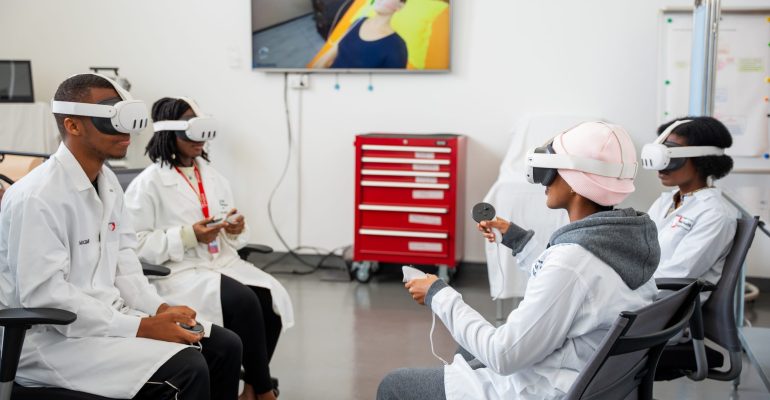
UGHE’s Simulation and Skills Centre provides a safe environment where students and health professionals can practice technical skills, teamwork, and decision-making before they ever face a high-stakes, real-world scenario. The Centre also extends beyond students, supporting practicing healthcare workers and training simulation instructors who can spread high-quality teaching across the region.
Since launching in 2019, UGHE’s Simulation and Skills Centre has grown into a cornerstone of healthcare education in rural Rwanda. UGHE has trained more than 250 trainees and delivered 90+ unique training sessions. In 2023, the Centre received an ASPIRE Certificate of Merit in Simulation from the Association for Medical Education in Europe (AMEE), reflecting its rising regional influence.
UGHE’s Simulation and Skills Centre now operates under the Centre for Transformative Learning and Technologies (CTLT), which launched in 2024. CTLT aims to reduce inequities in healthcare by pioneering practical, purpose-driven uses of innovation and partnerships, so more learners and health systems can access clinical excellence.
Beyond simulation, CTLT is building a broader ecosystem of technology-enabled transformative learning systems. Through virtual reality (VR), learners can rehearse complex procedures and high-pressure scenarios in immersive environments, especially useful for rare cases and for repeated practice. Leveraging artificial intelligence (AI) training becomes more responsive and measurable, as data is used to tailor practice, identify where learners are struggling, and strengthen feedback and assessment over time. And through innovation in LLM enabled platforms such as “One Space Africa” and applications of design thinking brought into practice CTLT aims to extend high-quality instruction beyond campus, supporting hybrid online delivery, shared modules across training sites, and continuous professional development for health workers. Together, these initiatives reinforce the same goal as the facility expansion: making clinical excellence more accessible, consistent, and scalable across Rwanda and the region.
A long-term investment
UGHE is now preparing to take its learning environment to the next level. CTLT is expanding its facilities, an investment not only in new buildings, but in the leaders of tomorrow. The planned development will integrate experiential learning, research, and digital technology to redefine health education in Africa, strengthen health systems, and prepare graduates who can lead globally.
The expansion will include seven classrooms, each designed for approximately 110 learners, creating the scale needed for a growing student body and modern, interactive teaching; a four-story Transformative Learning Center to support collaborative learning and technology-enabled teaching; and a Biomedical Science laboratory to strengthen research capacity and hands-on training, supporting both teaching and scientific discovery.
As simulation capacity expands, learning changes in practical ways: students get more opportunities to practice, more often, and repetition builds competence. With increased space and resources, teams can run more clinical scenarios and debriefs, strengthening not only technical procedures but also the “invisible” skills of communication, coordination, and decision-making under pressure. Expanded capacity also makes interdisciplinary simulation easier, reflecting how modern healthcare depends on well-functioning teams rather than individual performance.
This is where CTLT becomes central. CTLT was established to reduce inequities in healthcare by using artificial intelligence, immersive simulation, and data analytics to strengthen training systems and support health system improvement at scale. Its 2030 vision is to become a major African hub for AI- and simulation-enhanced medical education, extending expertise to more than 15 clinical training sites and sharing best practices for sustainable, socially grounded learning. A larger, purpose-built facility makes these goals more achievable.
The Biomedical Science laboratory complements this work by bridging classroom theory, clinical reality, and national priorities in Rwanda. At UGHE, biomedical sciences are integrated with practical lab work and simulation, helping students build testing skills and interpret results in clinical contexts. Stronger lab infrastructure deepens hands-on learning, expands locally relevant research, and enables solutions shaped by Rwandan community needs to be shared across Africa and beyond.
The Transformative Learning Center represents a shift away from passive lectures toward active, collaborative, technology-enabled education. It supports small-group learning, hybrid teaching across sites, digital tools that make learning measurable and adaptable, and faculty development, built on the idea that leadership is formed through practice, feedback, and responsibility.
UGHE’s impact is designed to extend beyond its campus, and the launch of the Consortium of Medical Schools–Africa (COMS-A) in Kigali in March 2025 strengthens that regional role. As an African-led platform, COMS-A promotes collaboration, resource sharing, and the exchange of best practices in medical education, research, and healthcare delivery, focused on building a socially accountable health workforce aligned with Africa’s health priorities. UGHE serves as the consortium’s secretariat. In this context, a new facility becomes more than a campus upgrade: it becomes enabling infrastructure for continental coordination.
With expanded classrooms, a modern learning center, and stronger laboratory capacity, UGHE can host educators, researchers, and innovators from across Africa and translate “best practices” into shared systems; co-developed curricula, joint faculty development, harmonized simulation scenarios, and multi-site research collaborations. Just as importantly, this convening power supports standard setting, allowing partners to align on common competency expectations, assessment benchmarks, and quality standards for simulation design and delivery, so training is not only innovative but also comparable, reliable, and scalable across institutions. In line with this, CTLT’s vision emphasizes regional and global convenings and collaboration with partners such as COMS-A, helping ensure that effective approaches spread from one campus to many.